








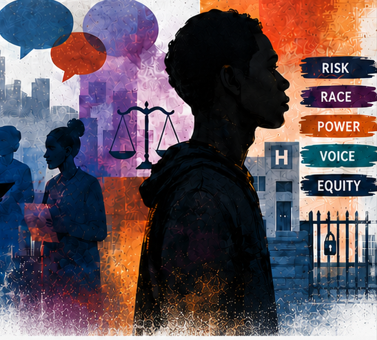
New research has shed light on why people from Black and minority ethnic communities are more likely to be detained under the Mental Health Act.
The PhD study, led by Dr Peter Baffoe, examined how frontline decisions are made by Approved Mental Health Professionals - the practitioners responsible for deciding whether someone should be detained for assessment or treatment.
Using detailed observations and interviews in two London boroughs, the research - co-funded by the University of Kent and the Applied Research Collaboration Kent, Surrey and Sussex - combined insights from professionals and Black service users to understand how decisions play out in practice.
Risk assessments are not neutral
A key finding is that risk is interpreted differently depending on who the person is.
The study found that when assessing Black individuals, professionals were more likely to focus on perceived risk to others, rather than risk to the individual. This shapes decision-making and can lower the threshold for detention, leading to more restrictive interventions.
Dr Baffoe describes this as a “risk veneer” - where decisions appear objective on the surface, but underlying assumptions linked to race influence how risk is understood and acted on.
Hidden bias within professional decision-making
The research shows how language and policy can give the impression of fair and neutral practice, while masking unequal treatment. This “veneer” can make bias harder to recognise and challenge within the system.
The findings also reveal that Black service users and their families are often excluded from decision-making. Many reported that their views were dismissed or undervalued, limiting their ability to influence care decisions -resulting in their voices not being heard.
Impact on care and trust
These patterns have significant consequences. They can lead to more restrictive care, particularly for young Black men, and contribute to stigma and mistrust in mental health services.
The research also highlights how unequal decision-making is not just about individual choices but reflects wider systems and practices around how risk is defined and managed.
Driving change
The study points to the need for change across policy and practice, including:
- Challenging assumptions about risk.
- Involving Black communities more meaningfully in decisions.
- Valuing lived experience alongside professional judgement.
- Investing in community-based alternatives to detention.
Dr Baffoe’s research shows that improving how decisions are made could help create a fairer and more equitable mental health system - where people’s voices are heard and respected.
Find out more
Read Challenging inequality in mental health detention: why race, risk and voice matter
This research was co-funded by the University of Kent and the National Institute for Health and Care Research Applied Research Collaboration Kent, Surrey and Sussex.
The views express are those of the author and not necessarily those of the NHS, the NIHR or the Department of Health and Social Care.
