








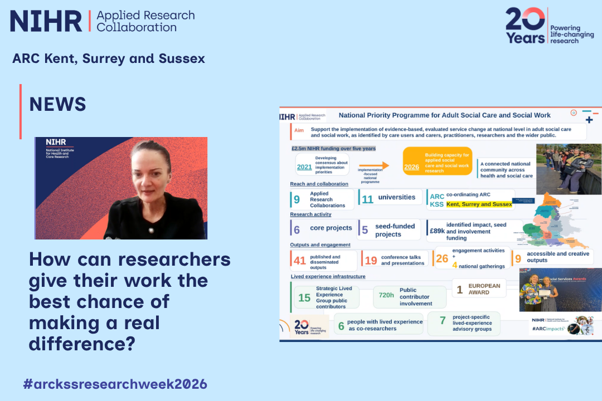
Building trusted relationships, involving people with lived experience and planning for impact from the outset can help research influence policy and practice.
Dr Madalina Toma, Senior Research Fellow at the National Institute for Health and Care Research (NIHR) Applied Research Collaboration Kent, Surrey and Sussex (ARC KSS) and the University of Kent’s Centre for Health Services Studies (part of the London and South East University Group), shared six practical lessons for researchers during ARC KSS Research Week (14–17 September).
Her advice focused on the conditions that can help evidence move beyond an individual research project and make a lasting difference.
The lessons came from the 5-year NIHR National Priority Programme for Adult Social Care and Social Work, which ARC KSS led on behalf of a national consortium of 8 other ARCs across the country.
The programme brought together researchers, practitioners, policymakers and people with lived experience. Projects explored topics including care planning in care homes, digital technology for community dwelling older people, multi-agency responses to domestic abuse, and strengths-based approaches to support in adult social care and social work.
“Partnership was not a backdrop to the research; it was part of the implementation method,” said Dr Toma. “Trust, communication and sustained commitment were essential to turning evidence into action.”
She also encouraged researchers to judge involvement by the difference it makes, rather than simply by the number of people taking part.
“We learned that counting involvement isn't enough. The real question is whether lived experience changed decisions and influenced outcomes.”
Six practical tips
1. Build partnerships early. Make time to develop trust, communicate clearly and agree shared goals.
2. Involve people throughout. Include people with lived experience in decision-making from the start of the project to the end.
3. Look beyond participation numbers. Consider how involvement has shaped decisions, research methods and outcomes.
4. Plan for impact from day one. Identify who could use the findings and involve them early.
5. Provide the right support. Allow enough time, funding and practical support to make involvement meaningful.
6. Build networks that last. Invest in relationships and leadership that can help evidence reach new audiences and influence policy and practice.
Dr Toma said the programme showed that achieving impact requires more than producing strong evidence. Research teams also need to invest in relationships, inclusion and long-term collaboration so that findings can reach the people able to use them.
Missed the session? Watch the recording.
