
Knowledge Mobilisation in practice

SW is a NIHR Applied Research Collaboration Kent, Surrey and Sussex (ARC KSS) Knowledge Mobilisation Fellow and Whole System Approach Obesity Officer at Kent County Council. Her work focuses on reforming the Postural Stability Service in Kent to help older adults stay active and prevent falls through more accessible, community-led physical activity services.
What inspired you to focus on reforming the commissioning model for the Postural Stability Service in Kent? Tell us a little bit about your project: Helping older adults stay active and prevent falls?
I was inspired by public and service provider feedback via focus groups and consultation survey. We plan to replace the two existing postural stability services with several new physical activity services, which will be funded through small grants.
Could you share how your background as a physiotherapist and public health officer has shaped your approach to this project?
It has broadened my understanding of the importance of physical activity as a prevention strategy. It has also increased my awareness of the complexity of meeting a wide variety of public preferences and allowed me to connect with Kent service providers that will benefit from this commissioning change.
How would you describe the role of knowledge mobilisation in this project, and what does it look like in practice?
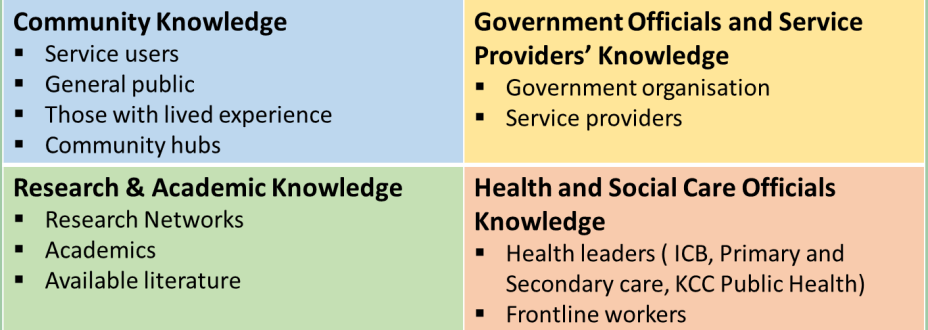
Engaging a wide variety of stakeholders to gain knowledge, so it can be shared with the right people, at the right time, to ensure the new proposed services are accessible and acceptable to the older adult audience. Examples of those engaged:
How did you ensure meaningful co-production with service users and community partners during the redesign process?
We sought feedback on the communication campaign for the proposed new physical activity service delivery. An expert panellist were engaged to gain insights on documents being produced, such as grant application form and service user/provider surveys. Additionally, Future PCIE activities include:
- Road show event to increase awareness of physical activities by the public- I have already engaged with community leader who would like to work together to roll out this roadshow.
- Health and Social Care webinar-to increase awareness of the self referral/ Joy referral process to the physical activities-to increase reach.
- Public involvement to review information leaflets for research that plans to be undertaken following the roll out of the new physical activities.
How do you plan to measure the success of the reformed service, both in terms of outcomes and sustainability?
To measure the success of the reformed service, I plan to look at several factors:
- Economic impact: I'll conduct an economic analysis of the new physical activities.
- Community capacity: I'll track the number of providers who complete the mandatory Active Kent Training session and those who request and receive funding for further training.
- Social wellbeing: This will be assessed through interviews and qualitative data collection.
Knowledge mobilisation will continue to support this project through ongoing Public and Community Involvement and Engagement (PCIE) activities to ensure insights are gathered and used to improve the service commissioning and delivery model.
What lessons from this project do you think could be applied to other public health services or regions?
There are a few key lessons from this project that could be useful for other public health services or regions:
- It's important to engage relevant stakeholders early in the project and keep them updated throughout. This helps ensure everyone is on the same page and can contribute effectively.
- Keeping a reflection log after each engagement is crucial. This allows us to follow up on how the knowledge was used or to reflect on why it couldn't be applied in the local situation.
This research was funded by the National Institute for Health and Care Research (NIHR) Applied Research Collaboration Kent, Surrey and Sussex. The views expressed are those of the author(s) and not necessarily those of the NHS, the NIHR or the Department of Health and Social Care.